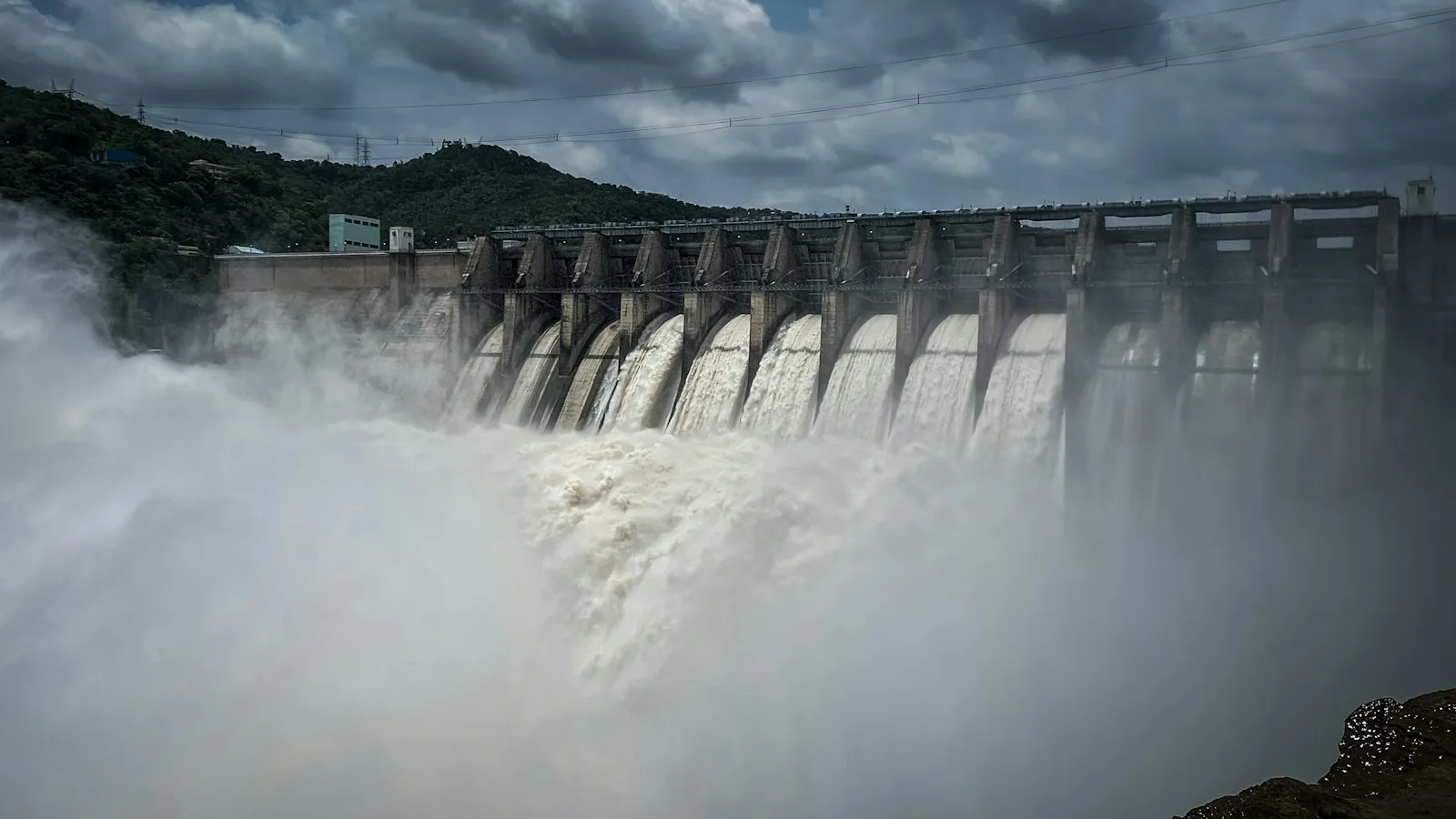
Most countries worry about where their next megawatt will come from. Paraguay has the opposite problem. A country of fewer than seven million people sits on one of the largest hydroelectric dams on earth, and for decades it has had more power than it knew what to do with.
That surplus is now one of the most interesting stories in Latin America. First it pulled in Bitcoin miners. In 2026 it began pulling in the companies building artificial intelligence, and President Santiago Peña has made it clear he wants Paraguay to be part of that race.
A country that runs on rivers
Paraguay’s electricity comes almost entirely from three dams on its rivers. The biggest by far is Itaipú, on the Paraná river, which Paraguay shares with Brazil. Itaipú has around 14,000 megawatts (MW) of capacity. A megawatt is roughly enough to power several hundred homes, and Paraguay owns half of the dam, about 7,000 MW. That share alone covers around 86% of the country’s electricity demand.
On top of that, Paraguay gets about 1,600 MW from Yacyretá, a second dam it shares with Argentina, and 210 MW from Acaray, a smaller dam that is fully Paraguayan. Almost every kilowatt hour in the country is renewable.
For most of Itaipú’s life, Paraguay used only a fraction of its half and sold the rest to Brazil at close to cost. That is the root of the opportunity: a large, clean, reliable supply of power that the country has long wanted to put to better use at home.
The first wave: Bitcoin miners
Bitcoin mining is, in simple terms, running thousands of specialised computers around the clock to secure the Bitcoin network in exchange for new coins. The single biggest cost is electricity, so miners go wherever power is cheapest.
Paraguay was an obvious target. Around 2021 and 2022, miners reported paying about US$0.03 per kilowatt hour on industrial connections. Today Paraguay is the fourth largest Bitcoin mining country in the world, with about 4.3% of all the computing power on the network. The largest operator, the Canadian listed HIVE Digital, runs around 400 MW across two sites.
The state utility, ANDE, has done well out of it. Its revenue from crypto mining customers rose from about US$100 million in 2024 to about US$295 million in 2025. But the welcome has cooled. Industrial rates have roughly doubled, operators now have to pay three months of electricity upfront as a deposit (about US$4.5 million for a 40 MW site), and ANDE has said every current mining contract ends on December 31, 2027, with no extension. The number of legal mining customers fell from 71 at the start of 2025 to 41 in 2026.
The second wave: artificial intelligence
Training and running AI models needs enormous data centres full of chips, and those chips need a lot of steady power. In much of the world, power is now the main bottleneck for new AI capacity. Paraguay has it, and in 2026 the government moved to sell it to the AI industry instead.
In May 2026, at the end of a state visit to Taiwan, President Peña announced a plan with Taiwan to build a regional AI and digital infrastructure hub in Paraguay, financed equally by both countries. He described it as combining Taiwanese technology with Paraguayan energy, and said Paraguay was joining the AI race on its own terms. The site, size and timeline have not yet been published. Paraguay is one of the few countries that still recognises Taiwan diplomatically, which gives the partnership a political dimension as well as a commercial one.
Then, on October 22, 2026, came the first large project with real numbers attached. Crusoe, a US company that builds and runs AI data centres, announced a partnership with Araico, a Paraguayan energy and infrastructure developer, to build an AI campus next to the Itaipú substation at Yguazú in Alto Paraná. The first phase is expected online in 2027, with room to grow to about 280 MW. The United States Deputy Secretary of State said it could become the largest private foreign investment in Paraguay’s history, and Paraguay’s industry minister has put the full plan at US$12 billion.
ANDE signed a 15 year supply contract for the campus of up to 286 MW, starting at 6 MW in December 2026 and stepping up to the full amount from April 2029. The reported price is about US$48.91 per megawatt hour on the high voltage line, just under 5 US cents per kilowatt hour, priced in US dollars and adjusted for US inflation.
The government has also rewritten its rules for what it calls convergent industries: AI data centres, crypto mining and green hydrogen. AI data centres pay a dedicated tariff of around 4.4 US cents per kilowatt hour, set in US dollars over a 15 year horizon. The message from officials has been blunt. Paraguay’s telecoms chief summed it up as unplugging crypto and plugging in AI.
The catches
None of this is guaranteed, and it is worth being clear eyed.
- The surplus is finite. Paraguay’s own electricity demand is growing fast, and forecasts suggest the spare capacity will run out within a few years. Every large contract signed now uses up headroom that cannot be sold twice.
- Infrastructure is still catching up. Operators point to summer heat, limited international bandwidth and local blackouts as real obstacles for data centres, which need near perfect uptime.
- Power is no longer bargain priced. Rates have risen sharply since the early mining days and are now indexed to inflation.
- Timelines vary. Officials and companies have given different start dates for the same project, and the Taiwan hub is still at the announcement stage.
What it means if you are looking at Paraguay
For most of our clients, Paraguay’s appeal has little to do with data centres. It is one of the simplest residencies in the world to obtain, it has a territorial tax system that generally leaves foreign income untaxed, and it offers a path to citizenship after three years of permanent residency.
But the energy story matters. Billions of dollars of foreign investment, new transmission lines and a growing technology workforce change a country. Alto Paraná and the area around Itaipú in particular are likely to see demand for construction, logistics, housing, security and professional services. For entrepreneurs in energy intensive fields, Paraguay remains one of the few places where large blocks of clean power can still be contracted at all.
If you are considering a business in Paraguay, the investor route can lead straight to permanent residency, and a local EAS, Paraguay’s simplified company, can be set up quickly. We help with both, working with our local team for tax and legal advice.
This article is general information, not investment, tax or legal advice. Figures come from the public sources below and can change.